The aviation industry is an important industry to Canada as it provides access throughout the geographically sparse country, enables remote and northern communities to receive essential goods and services, and of course it allows us to visit friends and relatives, travel for leisure or do business.
In order to get you from point A to B, many different entities are involved. The airline you choose to book will enable you to get between two locations – but who else is involved? Airports on the one hand allow the airline to land and takeoff and make use of their airport infrastructure. Airports also have ground handling services to assist the airline such as baggage handling, refueling and other items such as de-icing. Once you are in the sky, the air navigation service provider (ANSP) provides air traffic control services to the airline, allowing for a safe and efficient flight. For the passenger to board an airplane, they need to be free of any security threat and must go through airport security. In Canada, this is provided by the Canadian Air Transport Security Authority (CATSA).
The provision of services vary
Airlines are private entities. Major airports are non-for-profit (NFP) entities who operate Canadian airports. These airports, however, do not own the land and pay rent to the federal government for use of the land. Regional and remote airports may be non-for-profit, municipally owned or government owned and operated. Ground handling services are private entities. NAV CANADA, Canada’s ANSP is a private NFP. CATSA is a crown-corporation, meaning it is a commercialized entity of the government. These entities all have different structures, but they do have one thing in common. Historically, the provision of air services (meaning the entire operation from point A to B) was owned and operated by the government. Even Canada’s major private airline, at one point was a government owned airline.
So what changed?
Canada’s airline industry deregulated in the late 1980’s, meaning no government control on routes of airfares. This stemmed from the United States deregulation, which demonstrated many benefits such as more access and lower fares. This commenced a global catalyst for deregulated airline markets. With this deregulation, the Canadian government slowly started to privatize and commercialize other aspects of the value chain as a method of cost saving, and a way to increase efficiencies in operations.
If the government was not providing any means of financing for these entities now – how could these organizations operate?
Meet the user-pay system
The user-pay system is a system in which the full cost of the good or service is passed on to the user. Several user fees are now an integral part of the Canadian aviation system. The main user fees are outlined below:
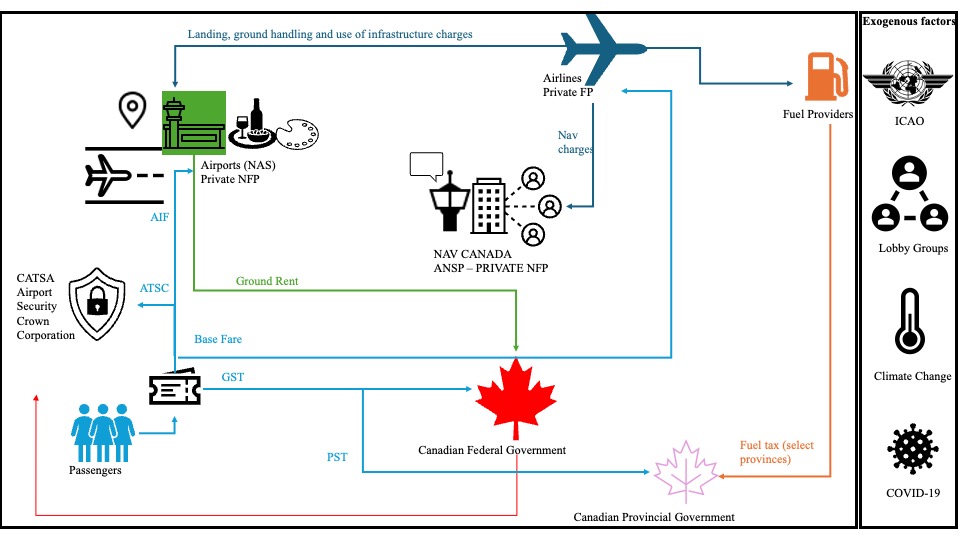
- Airport Improvement Fee (AIF) – A fee passed directly onto the air traveller by the airport to pay for use of the airport
- Air Traveller Security Charge (ATSC) – A fee passed directly onto the air traveller by CATSA to pay for the provision of security
- Air Navigation Charges – Charges passed on to the airline to make use of Canadian airspace and airspace infrastructure
- Fuel Providers – A tax on jet fuel
- Airport ground rent – Charges passed on to the airports as a percentage of revenue collected by the federal government
The below image outlines the flow of charges in the Canadian aviation system
Some of the above icons were used from icons8.com, as per the usage agreement see the below links
<a target=”_blank” href=”https://icons8.com/icon/25056/air-traffic-control-tower”>Air Traffic Control Tower</a> icon by <a target=”_blank” href=”https://icons8.com”>Icons8</a> <a target=”_blank” href=”https://icons8.com/icon/47036/runway”>Runway</a> icon by <a target=”_blank” href=”https://icons8.com”>Icons8</a>
<a target=”_blank” href=”https://icons8.com/icon/kXll9Bzcx8XN/airport”>Airport</a> icon by <a target=”_blank” href=”https://icons8.com”>Icons8</a> https://icons8.com/icon/eYNSg7IcxKka/land
Though not all fees are directly passed on to the consumer, ultimately, they are indirectly borne by the air traveller.
The concept of the user-pay system is fair in theory, if you use a service, you should be the one who pays for the service. But what if you are not the only person who benefits from the service, such as in the case of airport security where all Canadians are benefiting from the mitigating security threats. And what happens when there are limited or no users, as like the case of the COVID-19 pandemic?
Is reform needed?
The pandemic highlighted a major flaw, which is that when there are no system users, there is no way to recuperate the cost of operations and business. All entities have high operating costs, so this posed a problem throughout the pandemic. What was the solution? Well, for one, user fees were increased post pandemic. Many airports have raised their AIF upwards of 50%, the ATSC was increased approximately 33% and NAV CANADA also adjusted their charging formula substantially. Increased fees have implication on air travel demand, and in the case of Canada this has significant implications on access. Other entities such as some airlines ceased operations, which has adverse effects on access and competition. Additionally, climate change action is needed to reduce the adverse environmental effects from travel. The International Civil Aviation Organization has commenced the Carbon Offsetting Scheme in International Aviation (CORSIA) which could ultimately lead to another fee added to air travel in Canada.
The user-pay system has led to many calls for reform in the Canadian aviation industry. It is often attributed to being the reason that the cost of flying in Canada is relatively higher than in other countries. With an ongoing recovery from the COVID-19 pandemic, risks of future recessions and health crises, along with incentives to make more sustainable travel decisions, the user-pay system risks reducing the contribution of air transport to Canada’s socio-economic development and burdening air travellers.
Is Canada unique?
While Canada relies heavily on the user-pay system, many other countries use this system in one way or another. For example, Australia has a similar airport structure to Canada, where the federal government also owns the land that private entities operate on. One major difference in Australia is that rent payed to the government was based on a lease agreement with set pricing, uncorrelated to the annual revenues collected. As time goes on, the rent is likely less burdensome to the airports, and therefore the system user. Additionally, Australia has economic price monitoring as a policy for airport fees. In Canada, there is limited regulatory oversight on the fees airport set.
Air Navigation Service providers on the other hand, are generally owned and operated by the federal government, for example in the United States, Australia, France and Germany.
Security oversight and provision vary, with many countries having a set fee for these services that are sometimes subsidized or covered by taxation.
Additionally, many countries invest a significant portion of the taxes collected from aviation back into the aviation system. While Canada does do this in the form of programs like the Airport Capital Assistance Program, the dollars collected outweighs the dollars reinvested.
The major difference between other countries that make use of the user-pay system and Canada, is that generally their systems have policies implemented for price monitoring, involve some form of government ownership or government hand, and tend to reinvest some money back into the industry. Canada’s current system is a relatively hands off economic approach from the federal government.
Understanding objectives and priorities
The Canada Transportation Act (CTA) outlines several objectives for a national transportation system. Some of these objectives are being safe, secure, environmentally sustainable, competitive, efficient and advancing the well-being of Canadians. It is arguably said, given the increasing fees, lack of coordination and minimal government intervention, that not all these objectives are being met.
For a smooth flying experience that can enable the objectives of the CTA, all entities have to coordinate. As you may recall, the COVID-19 pandemic was a catalyst for causing many problems such as delays, lost baggage and sometimes what seemed to be overall chaos at Canadian airports. Many of these organizations have different priorities and preferences, which makes coordination and collective decision making difficult.
My research aims at determining alternative policies to the Canadian aviation system based on stakeholder objectives, which could also enable the objectives of the CTA. My goal is to make use of stakeholder preferences to determine what alternatives are viable, and if trade-offs exist between criteria to manage for in order to make improvements to the current system.
If you are an aviation professional who engages with policy decision making or lobbying, especially surrounding the topic of user fees, environmental policies or regulation, your opinion would be valuable to my research. In the coming weeks I will be looking for individuals to participate in an interview, if you are interested, please feel free to reach out to me at emmaneale@cmail.carleton.ca or fill out this form .
One response to “Introduction to my research”
-
Very interesting read, I look forward to seeing where this goes.
LikeLike


 Emma A. Neale
Leave a comment